How to draw a kitten — easy step by step drawing ideas
If you're hunting for kitten drawing ideas that actually work for small hands, you've landed in the right basket. Kittens are the most requested animal in every workshop I run — the moment I say "today we're learning how to draw a kitten," pencils shoot up like whiskers. And here's the happy secret: a kitten is just a big circle, two triangles, and a smile. Everything else is fluff, and fluff is forgiving.
I once taught this tutorial to a table of six-year-olds who each insisted their kitten needed a name before it could be drawn. By the end of the session we had Marmalade, Sir Pounce, and a kitten named "Toast" with one ear bigger than the other — which its artist declared was for hearing snacks being opened. That's exactly the spirit this tutorial is built for: simple steps, big personality, zero pressure.
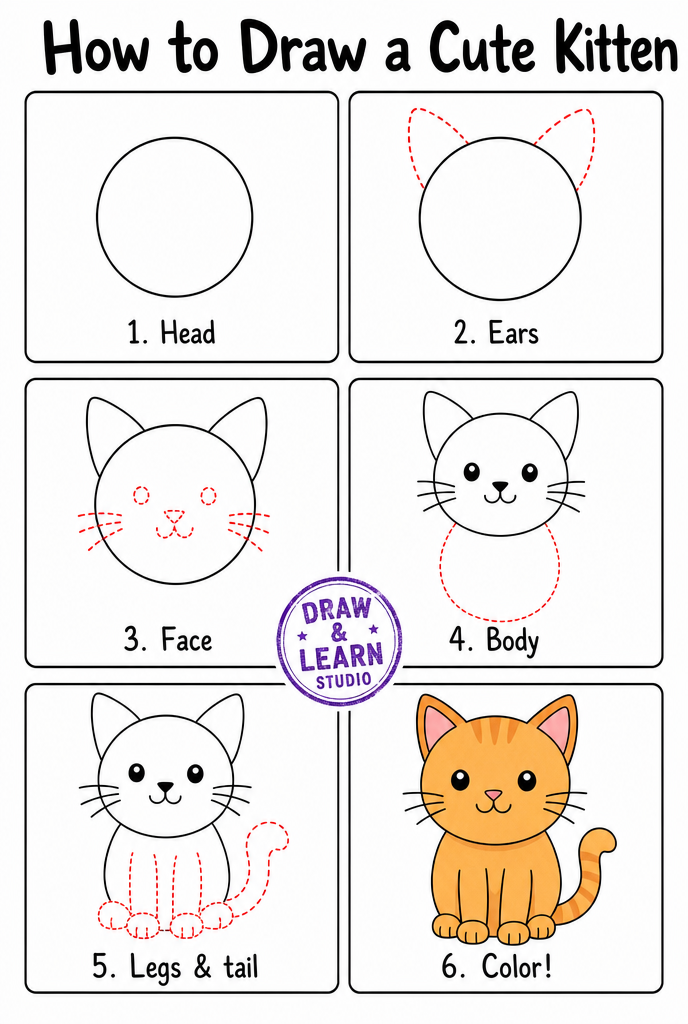
We'll build our kitten in six easy steps, exactly like the practice sheet below. Along the way I'll share the pro tips I use in real classes, the mistakes I see most often (and their two-second fixes), and troubleshooting for the classic "my kitten looks like a bear" emergency. Sharpen a pencil, grab something orange, and let's draw.
⏱️ Time: 15–20 minutes
⭐ Difficulty: beginner — great for kids 5+
✏️ Materials: pencil, eraser, paper, orange and pink crayons or markers
The 6 steps to easy kitten drawing ideas
Step 1 — Draw the round head

Start with one big, light circle a little above the middle of your paper. This is the kitten's head, and here's the number-one kitten rule: make it generous. Baby animals are mostly head, and that oversized circle is what will make your drawing read as "kitten" instead of "cat" from the very first step.
Keep your pencil whisper-light — think of it as sketching with a feather. Nothing in this step is permanent, and we'll darken only the best lines at the very end. If your circle comes out a little lumpy, congratulations: fluffy kittens are lumpy.
Step 2 — Add the triangle ears

Add two triangle ears on top of the head, one on each side. Kitten ears are wonderfully oversized compared to grown-cat ears, so let them be a bit too big — that's the cute zone. Point them gently outward, like the kitten just heard something interesting in two directions at once.
Then draw a smaller triangle inside each ear. That tiny inner triangle takes two seconds and instantly makes the ears look soft and dimensional instead of stuck-on. We'll color it pink at the end, which is scientifically proven (by every workshop I've ever run) to raise cuteness by at least forty percent.
Step 3 — Draw the body and front paws

Draw a rounded body below the head — and keep it small. The body should be about the same width as the head or even a little narrower, and not much taller. This squished baby proportion is the whole secret of kitten cuteness; if the body gets too long, your kitten quietly grows up into a cat.
Add two simple front paws at the bottom: just two small ovals sitting side by side, each split with two short lines to suggest toes. A sitting kitten is the friendliest, easiest pose there is — the body is barely more than a bean shape peeking out from under that big round head.
Step 4 — Add the curled tail

Sweep a thick, fluffy tail around from behind the body so it curls in front of the paws. Draw it as two curved lines that follow each other like train tracks, and don't be shy about the thickness — a skinny tail looks like a piece of string, but a plump tail looks like it belongs to something soft.
Let the tip of the tail end in a gentle rounded curve, almost touching the front paws. That "tail wrapped around the toes" pose is the universal symbol of a content, settled kitten, and it neatly frames the bottom of your drawing so the whole kitten sits in a tidy, huggable shape.
Step 5 — Draw the happy face and stripes

Now the personality arrives. Give your kitten two big round eyes in the middle of the face — bigger and lower than you think, that's the baby-animal trick — a tiny upside-down triangle nose, and a small w-shaped smile beneath it. Add three whiskers swooping out from each cheek.
Then add the tabby details: a few short curved stripes on top of the head between the ears, two or three on the back, and little rings on the tail. Stripes are the most forgiving decoration in animal drawing — wherever you put them, they look right, and they instantly turn a plain kitten into a proper marmalade tabby.
Step 6 — Finish and color

Darken your favorite lines, erase the light scaffolding underneath, and bring out the colors: warm ginger orange for the head, back and tail, cream or plain white paper for the muzzle, chest and paws, deeper orange for the stripes, and pink for the inner ears and nose. Press gently in layers — two light passes look smoother than one heavy scrub.
Want to level it up? Add rosy blush circles on the cheeks, a small ball of yarn beside the paws, or a patch of carpet for your kitten to sit on. And sign your name — every finished kitten deserves an artist's signature next to it.
Common mistakes to avoid
Making the body too big
The number-one kitten mistake: a long, large body under a normal head. The proportions flip from "baby kitten" to "regular cat" — still lovely, but not what we're after. The body should stay small, round, and tucked mostly behind that big head.
If the body already came out too big, don't erase everything. Just raise the ground: draw the tail curling higher across the body and add stripes to break it up — a fluffy tail hides a multitude of proportion sins.
Drawing the eyes too small and too high
Tiny eyes floating in the top of the face make a kitten look nervous, suspicious, or accidentally forty years old. Baby-animal eyes are big and sit low, around the middle of the face circle, with plenty of forehead above them.
The fix is happy: eyes can always get bigger. Circle each eye with a slightly larger circle and fill it in — you can grow eyes, but you can't easily shrink them, which is why we always sketch light in the early steps.
Pressing too hard too early
Dark, confident lines in steps 1–3 feel great in the moment and are nearly impossible to adjust afterward. Every kitten needs a nudge somewhere along the way — an ear moved, a paw resized — and heavy lines don't allow it.
Sketch every step like the pencil is barely awake, then press hard only in step 6 when you darken the winners. If dark lines have already happened, press an eraser straight down onto them instead of rubbing side to side — it lifts graphite without smearing.
Troubleshooting
"My kitten looks like a bear!"
Bears happen when the ears drift down the sides of the head and turn round. Move the ears to the top of the circle and make them clearly triangular with pointed-ish tips — triangles on top is the entire difference between kitten and bear cub.
"The whiskers ruined the face!"
Whiskers drawn too thick or too low can overwhelm a small face. Erase them and redraw with your lightest touch, starting from the cheeks (not the nose), curving gently outward and slightly down. Three per side is plenty — whiskers are a seasoning, not a main course.
"My stripes look like scribbles"
Stripes work best as short, curved, separate marks that follow the roundness of the body — think rainbow arcs, not straight bars. Space them out, keep them chunky, and always draw them in the same direction. When in doubt, fewer stripes look better than more.
Key takeaways
- A kitten is mostly head — big head circle, small round body, oversized triangle ears.
- Big eyes drawn low on the face are the instant "baby animal" trick.
- A thick tail curled around the front paws frames the whole drawing and reads as cozy.
- Sketch every step lightly first; darken only your favorite lines at the very end.
- Tabby stripes are forgiving — short curved marks that hide wobbles and add charm.
- Drawing the same kitten three times is the fastest way to get visibly better today.
FAQ
What age is this kitten drawing tutorial for? The six-step version works for ages 5 and up with a little help, and kids around 7+ can follow the sheet on their own. Adults who want relaxing drawing ideas are very welcome too.
How is drawing a kitten different from drawing a cat? Kittens are all head! Make the head circle bigger compared to the body, the eyes bigger and lower, and the ears slightly oversized. Those baby proportions are what make a drawing read as kitten instead of cat.
What materials do we need? Just a pencil, an eraser, paper, and orange and pink to color with. Crayons are the most forgiving for young kids; markers make the boldest, brightest kittens.
My kitten's face looks scared. How do I fix it? Scared faces usually come from eyes drawn too high and too small. Move the eyes down to the middle of the face, make them bigger, and curve the mouth into a small smile — the kitten instantly looks sweet again.
Keep drawing! 🐱
If your young artist is hooked, our step-by-step drawing book is the top pick in our studio — 320 animals taught in the same easy 6-step style as this tutorial. Pair it with a chunky set of washable markers and a spiral sketchpad (spiral bindings lie flat, which little hands love), and quiet afternoons take care of themselves.
Get the book on AmazonThat's your kitten! Whether it came out storybook-sweet or wonderfully wobbly, you built a whole marmalade tabby from a circle, two triangles, and a curly tail — and that absolutely earns fridge-front placement. Keep the sheet handy, draw a litter of littermates, and come back tomorrow for a new tutorial.
More tutorials: All tutorials · How to draw a cat · How to draw a puppy · How to draw a bunny